


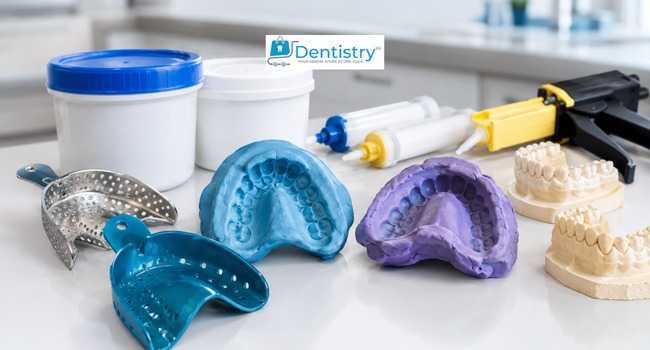
Dental impression materials record the shape of teeth and surrounding tissue so a lab or chairside workflow can turn that record into an accurate cast. The material you pick shapes detail, stability, and handling, and it often decides whether a restoration seats cleanly the first time.
What Are Dental Impression Materials?
Dental impression materials are moldable substances that set inside a tray and leave a negative copy of the oral structures. Pour dental stone into the set impression and you get a cast or diagnostic model.
Most materials in use today are elastic, so they pull free of undercuts without permanent distortion. In practice, what separates them is viscosity, tear strength, hydrophilicity, and setting time.
Types of Dental Impression Materials
The main types of dental impression materials are alginate, elastomeric materials, putty, and bite registration materials.
Alginate
Alginate is an irreversible hydrocolloid. It sets fast, costs little, and works well for study casts, diagnostic models, and opposing arches. It gives up some detail and loses dimensional stability as it dries or absorbs water, so pour it soon after removal.
Elastomeric Impression Materials
Elastomeric impression materials are synthetic polymers with high elastic recovery, and they are the standard for definitive impressions. They come in different viscosities, such as light body for wash layers and regular body impression material for general use. Two groups dominate: PVS and polyether.
PVS (VPS)
Polyvinyl siloxane holds its dimensions well, reproduces fine detail, and comes in several viscosities. Hydrophilic versions cope better with moisture. Residue from latex gloves can inhibit setting.
Polyether
Polyether is naturally hydrophilic and captures detail well. It is stiff, has a short working window, and takes up water, so keep finished impressions dry.
Dental Putty Impression Material
Dental putty impression material is a heavy-bodied elastomer, usually PVS. In a putty-wash technique, putty elastomeric impression material acts as a rigid tray for a light body elastomeric impression material wash, giving you support and fine margin detail together.
Bite Registration Material
Bite registration material records how the arches meet. Fast-setting, rigid formulations resist distortion when you mount the casts. A dedicated bite registration impression material keeps this step separate from your main impression.
Dental Impression Materials: Common Uses
Diagnostic models and study casts: treatment planning and case records
Crowns and bridges: elastomeric impressions of preparation margins
Dentures: alginate for preliminary impressions, a suitable elastomer or other final material for the definitive one
Implant impressions: elastomeric material with transfer copings
Bite registration: mounting casts and checking occlusion
How to Choose the Right Dental Impression Material
Start with the procedure, then look at handling.
Accuracy: Definitive prosthodontic work usually calls for PVS or polyether. Alginate fits preliminary records.
Dimensional stability: If casts will be poured later or shipped to a lab, choose a stable elastomer.
Working and setting time: Several preparations need a longer working time. A shorter setting time saves chair time.
Moisture control: If keeping the field dry is a struggle, consider hydrophilic PVS or polyether.
Tear strength and elastic recovery: These matter around subgingival margins and undercuts.
Tray compatibility: Confirm whether the material needs tray adhesive.
Storage and cost: Check shelf life, delivery format, and cost per case.
Impression Material Comparison
Material | Key characteristics | Common uses | Considerations |
Alginate | Fast, economical, limited stability | Study casts, preliminary impressions | Pour promptly |
PVS | Stable, precise, multiple viscosities | Crowns, bridges, implants | Glove contamination; moisture-sensitive if not hydrophilic |
Polyether | Hydrophilic, stiff | Crowns, implants | Short working time; store dry |
Putty | High viscosity, tray support | Putty-wash impressions | Needs a light-body wash for detail |
Bite registration | Rigid, fast-setting | Mounting casts | Trim carefully |
Dentistry99 Impression Materials
Dentistry99 stocks PERFIT impression materials for putty-wash and occlusal record workflows, including putty, light body, regular body, and bite registration options. Browse the full Dental Materials category and check each product page for specifications and instructions for use.
Ready to Stock Up?
Dentistry99 supplies dental impression materials for the full range of clinical workflows, from alginate for preliminary records to elastomeric materials for definitive crowns, bridges, and implant cases. Explore our Dental Materials category to compare putty, light body, regular body, and bite registration options, then check each product page for specifications. Choose materials that match your accuracy requirements, handling preferences, and laboratory workflow.
FAQs
What is dental impression material used for?
It records teeth and soft tissue so a lab or chairside system can make casts. Those casts support diagnosis, treatment planning, crowns, bridges, dentures, implants, and occlusal analysis.
Which impression material is most commonly used?
Alginate is widely used for preliminary impressions and study models. PVS is common for definitive impressions because of its accuracy and stability. The right choice depends on the procedure.
What affects impression accuracy?
Material properties, tray selection, moisture control, mixing, working and setting time, disinfection, and how soon the cast is poured. Technique matters as much as the material.
How does alginate differ from elastomeric material?
Alginate is an economical hydrocolloid for preliminary work, with limited stability. Elastomeric materials such as PVS and polyether reproduce finer detail and hold their dimensions longer.
Dentistry99 Store
Need supplies for your practice?
Shop trusted brands with free standard shipping on qualifying orders.


