


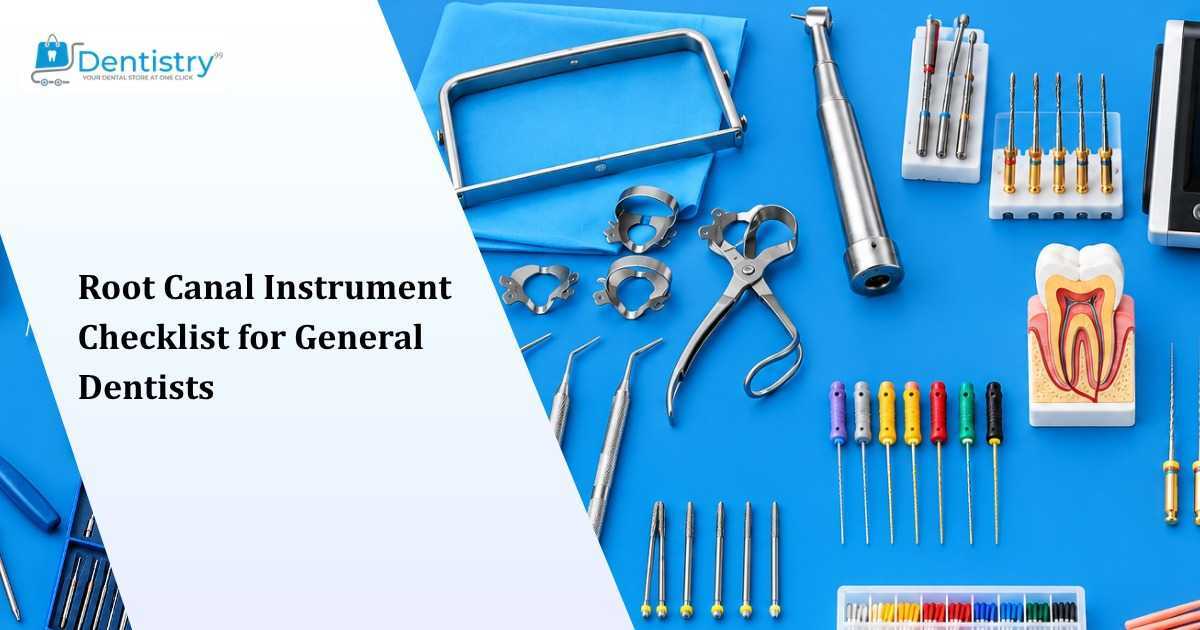
What Instruments Are Used in Root Canal Treatment?
Root canal treatment uses a series of specialised instruments to isolate the tooth, create access, locate the canal orifices, measure working length, clean and shape the canals, deliver irrigants, dry the canal space and complete obturation. A typical setup may include a dental dam, endodontic explorer, hand files, rotary instruments, an apex locator, irrigation syringe, paper points, gutta-percha and restorative materials. The exact selection depends on the tooth, canal anatomy, treatment method and whether the procedure is routine or a retreatment case. This guide explains the instruments used at each stage, helping general dentists prepare a practical endodontic tray and identify which tools are essential, optional or mainly used for complex cases.
Root Canal Instruments by Treatment Stage
Isolation Instruments
Effective isolation helps keep saliva and contaminants away from the operative field while improving visibility and patient safety. A rubber dam setup commonly includes a sheet, punch, clamp, clamp forceps and frame.
A dental dam frame supports the dam around the mouth and keeps the working area clear. Adult and child frame variants may be selected according to the patient and treatment site.
An Ainsworth rubber dam can be used as part of the isolation setup. The dentist should select the appropriate clamp, ensure the dam is stable and check the seal before beginning access preparation.
Access Preparation Instruments
Access preparation creates a direct path to the pulp chamber and canal orifices. The aim is to provide sufficient visibility and instrument control while preserving as much healthy tooth structure as possible.
Common access preparation equipment includes:
High-speed dental handpiece.
Round burs for initial entry.
Endodontic access burs.
Endo-Z burs for refining cavity walls.
Long-shank burs for improved visibility in deeper chambers.
Ultrasonic tips for conservative troughing or removing calcifications.
The bur selection depends on the tooth, chamber anatomy and amount of calcification. Careful, controlled preparation helps reduce the risk of gouging, excessive dentine removal or perforation.
Instruments for Locating the Canal Orifice
Once the pulp chamber is exposed, the canal orifices must be identified and negotiated. A DG-16 explorer is commonly used to detect developmental grooves, catch the edges of canal openings and provide tactile feedback.
A D11T explorer may also be useful when examining restricted or difficult-to-see areas. Magnification, illumination and a clean chamber floor can improve visualisation, particularly in teeth with calcified or unusual anatomy.
The explorer should be used with controlled pressure. Excessive force can damage the chamber floor or create an inaccurate pathway.
Instruments for Determining Working Length
Working length measurement helps determine how far cleaning, shaping and obturation instruments should extend within the canal. An endo motor with apex locator combines electronic working-length measurement with motorised file control, depending on the device and treatment workflow.
An endo-implant ruler provides a manual method for measuring and verifying file lengths. It can be used as a practical back-up when checking file stops, cone length or measurements recorded during treatment.
Working length should be assessed using the appropriate combination of electronic measurement, tactile information and radiographic verification where indicated. Dentists should always follow the operating instructions for the apex locator and endodontic motor being used.
Root Canal Files for Cleaning and Shaping
Endodontic files remove pulp tissue, dentine debris and infected material while creating a shape suitable for irrigation and obturation. The file system depends on the canal anatomy, preparation technique and clinician preference.
Common instruments include:
K-files for canal exploration, negotiation, patency and initial preparation.
H-files for engaging dentine during withdrawal and removing debris.
Rotary nickel-titanium files for efficient shaping of curved or narrow canals.
Gates-Glidden drills for controlled coronal enlargement and orifice opening.
Hand reamers for enlarging the canal using a rotational motion.
Glide-path instruments for creating a reproducible pathway before rotary shaping.
Stainless-steel hand files are especially useful during initial canal negotiation because they provide tactile feedback. Rotary NiTi instruments can improve shaping efficiency but must be used according to the manufacturer’s recommended sequence, speed, torque and reuse guidance. Files should be inspected for unwinding, distortion or other signs of damage before use.
Irrigation & Activation Instruments
Irrigation helps flush debris, support chemical cleaning and reduce microorganisms within areas that mechanical instruments may not contact. The irrigation setup may include a syringe, delivery needle, irrigant, aspiration equipment and an activation device.
A 12cc curved-tip irrigation syringe supports controlled delivery of irrigating solution during canal preparation. The needle should be selected and used carefully to avoid binding, excessive pressure or unintended extrusion.
An UTA010 endo ultrasonic activator can be used to activate irrigants and improve fluid movement within the prepared canal. Activation is generally performed after establishing a suitable canal pathway and should follow the equipment instructions.
Other irrigation accessories may include:
Side-vented endodontic needles.
Irrigation cannulas.
Luer-lock syringes.
Aspiration tips.
Irrigant activation tips.
Irrigation measurement and storage accessories.
Irrigation protocols should be selected by a trained dental professional. The needle must remain loose within the canal, and the solution should be delivered with controlled pressure.
Drying the Canal
After cleaning and irrigation, the canal is dried before sealer and obturation materials are placed. Absorbent paper points, also called endodontic paper points, are inserted to remove residual moisture.
Paper points should be selected according to the prepared canal size and taper. They may also help the dentist assess whether the canal remains persistently wet or contains signs of fluid seepage. Endodontic tweezers or a cotton plier can assist with controlled placement and removal.
The canal should be dried according to the selected obturation and sealer technique. The correct level of moisture may vary between materials, so the manufacturer’s instructions should be followed.
Obturation Instruments
Obturation fills and seals the prepared canal space after cleaning, shaping and drying are complete. The equipment used depends on whether the dentist is performing cold lateral compaction, warm vertical compaction, backfill obturation or another technique.
Gutta-percha pellets are used with compatible thermal obturation equipment. Gutta-percha points, sealer, spreaders and pluggers may also be required depending on the chosen technique.
A cordless obturation heating pen provides heat-assisted control during warm obturation procedures. Heating equipment should be used according to the manufacturer’s instructions and with suitable gutta-percha materials.
A wireless gutta-percha cutter can trim excess gutta-percha cleanly after placement. Other commonly used obturation instruments include:
Finger spreaders.
Hand pluggers.
Heat carriers.
Backfill units.
Gutta-percha points.
Root canal sealer.
Obturation measuring and compaction accessories.
The chosen obturation instruments should match the canal preparation, filling method and restorative plan.
Retreatment Instruments
Retreatment may require additional instruments because the dentist may need to remove existing gutta-percha, sealer or other filling materials before locating and cleaning the canal again.
A specialised retreatment kit may contain instruments designed to support the removal of previous root canal filling material. Depending on the case, the setup may also include:
Retreatment files.
Rotary or reciprocating removal instruments.
Heat instruments.
Ultrasonic tips.
Solvent, where clinically appropriate.
Small hand files.
Irrigation and aspiration equipment.
Magnification and illumination.
Retreatment cases can involve blocked canals, separated instruments, ledges, calcification or altered anatomy. Instrument selection should therefore be based on the clinical findings rather than a fixed kit list.
Post-Obturation Restorative Materials
After obturation, the tooth usually requires a suitable coronal seal and restorative plan. The material selected depends on the remaining tooth structure, moisture control, occlusal demands and whether a temporary or definitive restoration is being placed.
A flowable composite may be used where a low-viscosity composite is appropriate for the planned restoration.
A universal composite restorative can support definitive restorative procedures when the case requires a composite material with broader shade or application flexibility.
An enamel coating resin may be used for suitable enamel-sealing or coating applications according to the product instructions.
A glass ionomer liner can be considered where a glass ionomer material is appropriate for the restorative plan.
These materials are not substitutes for case assessment. The final restoration should provide an effective coronal seal and restore function while accounting for the structural strength of the treated tooth.
Essential vs. Optional Root Canal Instruments
This section can be used as a priority guide when preparing a general dentistry endodontic tray.
Essential instruments
Most routine root canal setups require:
Isolation equipment, including a rubber dam, clamp and frame.
An endodontic explorer.
Small hand files for canal negotiation.
Cleaning and shaping files appropriate to the selected technique.
Working-length tools.
Irrigation syringe and suitable delivery needle.
Absorbent paper points.
Gutta-percha and sealer.
Spreader or plugger appropriate to the obturation method.
Basic access burs and a suitable handpiece.
The exact instruments will vary according to the tooth, canal anatomy, clinician training and treatment system.
Optional or case-dependent instruments
The following tools may be especially useful but are not required for every routine case:
Ultrasonic activation equipment.
An apex-locator and endo-motor combination.
Heat-assisted obturation equipment.
A retreatment kit.
Ultrasonic tips for calcified canals or retreatment.
Specialised glide-path systems.
Advanced irrigation equipment.
Post-space preparation instruments.
Magnification and enhanced illumination.
A general dentist does not necessarily need every specialist instrument for every case. The priority is to maintain a safe, repeatable workflow and use equipment that the clinician is trained to operate.
FAQs About Root Canal Instruments
What instruments are used in a root canal?
Root canal treatment commonly uses isolation equipment, access burs, an endodontic explorer, hand or rotary files, working-length measurement tools, irrigation syringes, paper points, gutta-percha, sealer and obturation instruments. Additional equipment may be required for curved, calcified or previously treated canals.
What is the difference between a K-file and an H-file?
A K-file is commonly used for exploration, negotiation, patency and hand preparation. Its design supports controlled filing and rotational movements. An H-file has a different cutting design and is primarily used with a withdrawal motion to engage dentine and remove debris. Both instruments must be used carefully and according to the clinical technique.
Do I need a rubber dam for every root canal?
A rubber dam is a fundamental part of endodontic isolation because it helps control moisture, improve visibility and reduce the risk of contamination or accidental swallowing of small instruments. Dentists should follow applicable professional standards, clinical guidance and local regulations when providing root canal treatment.
What is the best way to sterilise endodontic instruments?
Endodontic instruments should be cleaned, inspected, packaged and sterilised according to the instrument manufacturer’s instructions and the practice’s infection-control protocol. Single-use instruments should not be reused, while reusable instruments should be checked for damage before sterilisation. Follow the validated sterilisation cycle and maintain appropriate records.
Shop Root Canal Instruments at Dentistry99
Preparing the right endodontic setup helps general dentists move through treatment in a controlled and organised way. From isolation and canal exploration to irrigation, obturation, retreatment and coronal restoration, each instrument has a specific role in the workflow.
Explore Dentistry99’s selection of dental instruments, endodontic supplies, obturation products and restorative materials to build a root canal setup suited to your practice. Select products according to the treatment technique, case requirements, clinician training and manufacturer guidance.
Dentistry99 Store
Need supplies for your practice?
Shop trusted brands with free standard shipping on qualifying orders.


