


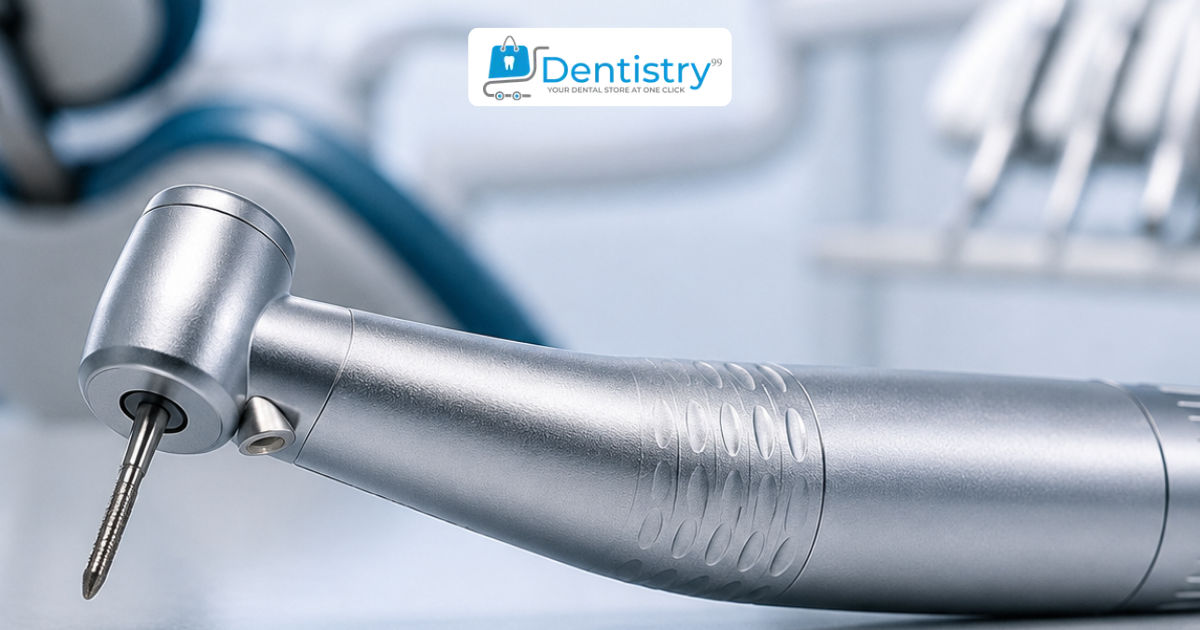
Walk into any operatory and you'll hear it before you see it — that unmistakable whir of a handpiece doing its job. It's such a familiar sound that most of us tune it out entirely, which is a shame, because there's a surprising amount of engineering packed into that small metal tool. A handpiece isn't just a "drill," even if that's what half your patients call it. It's the working hand of every dentist — a compact, precision instrument that drives burs and attachments to cut, shape, polish, and finish with real control.
And picking the right one isn't as simple as grabbing whichever handpiece spins the fastest. It comes down to matching torque, ergonomics, and infection-control features to the specific job in front of you, so you can move efficiently through a procedure while your patient stays comfortable in the chair. So whether you're a dental student still sorting out the terminology, a practice owner weighing an upgrade, or just someone wondering what exactly is spinning near your molars at 400,000 RPM — this guide walks through every major type of dental handpiece, how each one works, and why the choice actually matters for the quality of care a practice delivers.
What Is a Dental Handpiece, Exactly?
At its core, a dental handpiece is a motorized hand instrument that holds and drives rotary or reciprocating tools — burs, discs, polishers, files — to cut, shape, polish, or remove tooth structure and dental materials. You could think of it as the interface between a dentist's hand and the tooth itself, converting either air pressure or electric current into controlled rotational force.
These tools show up in nearly every operatory task you can name, from cavity prep and crown margins to polishing, endodontics, and implant surgery. And their design has real downstream effects — on visibility, on vibration, on noise, on heat — all of which shape both clinical accuracy and how the patient experiences the appointment. There isn't one "best" handpiece across the board; it really depends on the job at hand. High-speed for cutting through enamel quickly, low-speed for controlled finishing, electric when you need steady torque, and specialized units for surgery or root canal work.
Core Types of Dental Handpieces
1. High-Speed Handpieces (Air-Turbine)
These are the workhorses of restorative dentistry, and for good reason — high-speed air-turbine handpieces run anywhere from 180,000 up to 450,000 RPM, which is exactly the kind of speed you need to cut through enamel and dentin without sitting in the chair all afternoon. They're the go-to for cavity prep, crown and veneer preparation, and cutting through old restorations that need to come out.
Most are built with an internal water spray to keep the tooth cool while cutting, since heat buildup can damage the pulp if it's not managed. A friction-grip chuck holds the bur securely in place. The one trade-off worth knowing: these handpieces spin fast but don't carry much torque, so they'll stall if you push too hard. A light, feather-touch technique goes a long way here.
Good for cavity prep, enamel cutting, crown and veneer preparation, and quick access. On the downside, expect more noise and vibration, and performance really does depend on adequate water spray to keep heat under control.
2. Low-Speed Handpieces (Contra-Angle and Straight)
Low-speed handpieces live in a much gentler range — roughly 100 to 40,000 RPM — and what they lack in speed, they make up for in control and torque. Instead of cutting fast, they're built for the kind of work that needs a steady hand and real tactile feedback: removing soft or deep decay near the pulp, polishing restorations, refining endodontic access, running prophylaxis, or adjusting dentures and removable prosthetics.
These usually come as a motor paired with interchangeable attachments. Contra-angle heads make it easier to reach posterior teeth, while straight heads are better suited to lab work and anything outside the mouth.
Where they shine is polishing, finishing, careful caries removal, and denture or prosthetic adjustments. Where they fall short is speed — you wouldn't want to reach for one when you need to remove a lot of enamel quickly.
3. Electric Handpieces (Micromotor-Driven)
If there's one upgrade a lot of modern practices have made in the last several years, it's this one. Electric handpieces run on an electric micromotor instead of compressed air, and the payoff is consistent torque at any speed — something air-driven systems just can't quite match. Because they hold steady RPM even under load, you get smoother cuts, less chatter, and often a noticeably quieter experience for the patient in the chair.
One electric unit can usually cover both high-speed and low-speed work, just by swapping the attachment, which is part of why so many practices are standardizing around them — fewer systems to maintain, less clutter, simpler training for new staff.
They're particularly well suited to crown and bridge prep, implant osteotomy, zirconia or metal adjustments, and any procedure where consistent torque really matters. The catch is cost — electric systems ask for a bigger investment upfront, and the head can run slightly heavier or larger than an air-turbine equivalent.
4. Surgical and Implant Handpieces
Built specifically for oral surgery, implant placement, and anything involving bone, surgical handpieces are tougher than their restorative counterparts and run at lower, tightly controlled speeds. Most include external or sterile irrigation to prevent thermal necrosis of bone — a real risk if heat isn't managed during drilling. Precision isn't optional here; implant osteotomies and atraumatic extractions depend on exact torque and speed control.
These are the right tool for implant drilling, bone contouring, surgical extractions, and maxillofacial work generally. Before buying one, it's worth double-checking compatibility with your existing surgical motor and irrigation setup — mismatches here are more common than you'd expect.
5. Endodontic Handpieces
Endodontic handpieces are purpose-built to drive NiTi files, using either continuous rotation or reciprocating motion, and they've made root canal therapy noticeably safer and more predictable by cutting down on file separation and canal transportation. Most come with built-in torque management and interfaces that make canal shaping feel more intuitive.
They're the tool of choice for cleaning and shaping canals, creating a glide path, and retreatment with rotary or reciprocating file systems. One thing to keep in mind: always match the handpiece to your specific file system, and stick to the manufacturer's torque and speed settings rather than guessing.
6. Hygiene and Prophy Handpieces
These are typically low-speed, contra-angle units, and their whole job is powering the prophy angles and cups used for stain removal and polishing during routine cleanings. Because hygienists use these tools all day, every day, ergonomics matter more here than almost anywhere else — a lightweight, well-balanced handpiece can genuinely save someone's wrist over a long career.
They're built for routine prophylaxis, stain removal, and polishing existing restorations. Just be sure your choice between disposable and sterilizable prophy angles lines up with your practice's infection-control protocol.
7. Laboratory Handpieces
Lab handpieces are a different animal entirely — larger, more powerful, and never meant to go anywhere near a patient's mouth. They're built for trimming models, adjusting dentures, and finishing prosthetics, where removing material quickly matters more than delicacy.
Use them for model trimming, denture adjustments, and general bench finishing — and nowhere else. A lab handpiece should never be used intraorally, full stop.
Air-Driven vs. Electric: A Quick Comparison
Feature | Air-Driven (Turbine) | Electric (Micromotor) |
Typical RPM | Up to ~450,000 | ~100,000–200,000 (with gear ratios) |
Torque | Lower, can drop under load | Higher, stays consistent under load |
Noise/vibration | Generally louder | Quieter, smoother |
Weight/head size | Lighter, often smaller heads | Slightly heavier; larger head on some models |
Best fit | General restorative, fast cutting | Crown/bridge, implants, precision work |
Cost/maintenance | Lower upfront, more frequent servicing | Higher upfront, less frequent servicing |
The Role of Handpieces in Modern Dental Practice
It's tempting to think of a handpiece as "just a tool," but honestly, its role goes a lot further than spinning a bur.
Take precision and predictability — a well-calibrated handpiece delivers consistent cutting performance, and that consistency shows up directly in how clean a tooth preparation turns out and how well the final restoration fits.
Then there's patient comfort. Vibration, noise, and heat are the first three things a nervous patient notices, often before you've even started. Electric handpieces, and air-driven ones that are properly maintained, cut down on all three, which makes the whole appointment feel a little less intimidating.
There's also the matter of efficiency. Faster, torque-stable cutting means shorter chair time without giving up accuracy — a real difference when you're trying to stay on schedule with a full day of patients.
Safety and infection control matter too, since handpieces come into direct contact with saliva, blood, and aerosols all day long. Features like autoclavability, internal water lines, and anti-retraction valves aren't just nice extras — they play a direct role in preventing cross-contamination.
And finally, longevity. A handpiece with worn bearings or poor concentricity can quietly cause uneven tooth prep, which eventually shows up in how well crowns, fillings, and bridges seat and hold up over time.
If you're comparing options across brands and specs, it's worth spending time with a dedicated resource on dental handpieces to get a feel for the full range of speeds, torque ratings, and attachment systems out there before you commit to a purchase.
Handpiece Accessories That Complete the System
A handpiece rarely does its job alone — a few supporting pieces of equipment matter just as much.
Air-water syringes deliver the combined spray that rinses away debris and keeps the operative field visible and cool. It sounds simple, but the way that spray is engineered actually has a real effect on both precision and patient comfort — something we've covered in more depth in this breakdown of how a 3-way air-water syringe improves operatory precision and performance.
Obturation devices are another piece of the puzzle, used in endodontics to fill and seal root canal systems once cleaning and shaping is done. These have gone cordless in recent years, and if you're curious how that shift is changing root canal workflows day to day, this piece on wireless obturation heating pens for endodontic precision is worth a look.
Put together, handpieces and their accessories form the backbone of a functioning operatory. Neither really works at its best without the other.
How to Choose the Right Dental Handpiece
There isn't a single "best" handpiece out there — the right one depends on the procedure, your own preferences as an operator, and what your practice can reasonably budget. A good place to start is with the procedures you do most often, then work backward from there:
Speed and torque — high RPM for enamel cutting, high torque at low RPM for implants and denser materials.
Head size and access — smaller heads give you better visibility in the posterior regions.
Ergonomics — weight, balance, and grip all add up over a long clinical day, more than most people realize.
Compatibility — check that couplers (2–6 hole), motor systems, and bur shanks (FG vs. RA) actually match what you already have.
Infection control — sealed heads, anti-retraction valves, and fully autoclavable designs should be non-negotiable.
Noise and patient comfort — a quieter handpiece helps anxious patients and, honestly, saves your own nerves too.
Total cost of ownership — factor in service intervals and parts availability, not just the price tag on day one.
A deeper comparison of the different dental handpiece models, torque specs, and maintenance requirements can make this decision a lot easier, especially if you're upgrading several operatories at once. And if you're standardizing equipment across the practice, it's genuinely worth demoing a few units chairside first — specs on paper only tell you so much about how something actually feels in your hand.
Maintenance and Sterilization: Protecting Patients and Your Investment
Even the best handpiece on the market won't perform well without proper care. A routine that's easy to stick to looks something like this:
Purge and wipe the handpiece for 10 to 30 seconds to clear the lines, then wipe down the exterior after every single patient. Clean it internally using manufacturer-approved irrigation or cleaning systems — never immerse the handpiece itself in liquid. Lubricate with the recommended oil before sterilization, unless your system is designed to be lube-free. Bag and autoclave it following the manufacturer's exact cycle parameters, and let it cool down fully before putting it back into rotation. Every so often, take a moment to inspect the chuck grip, check that rotation feels smooth, confirm the light and spray are working, and listen for any unusual noise or heat. And when it's not in use, store handpieces dry and upright, rotating stock by sterilization date so nothing sits idle for too long.
None of this is glamorous, but staying consistent with it cuts down on overheating, bearing wear, and the kind of unexpected downtime that throws off a whole day's schedule — protecting both your patients and the equipment itself.
Reducing Wrist Strain and Improving Control
Anyone who's used a handpiece for years knows repetitive strain is a real occupational hazard, not just a theoretical one. A few habits genuinely help: hold the handpiece the way you'd hold a pen, gripping near the neck without pinching too hard. Position your patient so your wrists stay neutral and your elbows stay close to your body, rather than reaching or twisting. Build in short breaks between procedures to reset your grip and stretch your hands. And when you're choosing a handpiece, pick one that's actually balanced for your hand size and grip style — not just whatever happens to be cheapest or already sitting in the drawer.
Frequently Asked Questions
What is the difference between a high-speed and low-speed dental handpiece?
High-speed handpieces cut fast — up to 450,000 RPM — with lower torque, and they're used for cutting tooth structure. Low-speed handpieces run slower, up to about 40,000 RPM, but with higher torque, which makes them better suited to polishing, finishing, and careful decay removal.
Are electric handpieces better than air-driven ones?
Not necessarily "better" across the board — electric handpieces offer more consistent torque and smoother cutting at all speeds, but air-driven handpieces still hold their own thanks to a lower upfront cost, lighter feel, and simpler maintenance.
How often should a dental handpiece be serviced?
Most manufacturers suggest every 6 to 12 months, though practices with heavier patient volume may need to service more often to keep bearings and turbines running the way they should.
Can one handpiece be used for every procedure?
Not really, no. Most practices end up relying on a mix — high-speed for cutting, low-speed for finishing and hygiene, and electric, surgical, or endodontic handpieces for more specialized work.
What's the difference between FG and RA burs?
FG, or friction-grip, burs are used with high-speed handpieces and held in place by a chuck. RA, or right-angle, burs go with low-speed contra-angle attachments and are secured with a latch mechanism instead.
Final Thoughts
Dental handpieces are small, but they carry a lot of weight in every procedure they're part of — from a routine cleaning all the way to a complex crown prep or implant placement. Understanding the different types, their speeds, and where each one fits isn't just academic knowledge for its own sake; it directly shapes the quality, comfort, and safety of the care a practice delivers. Whether you're outfitting a brand-new operatory, standardizing equipment across several rooms, or just replacing a turbine that's finally worn out, matching the right handpiece to the right task remains one of the simplest ways to raise the everyday standard of care.
Dentistry99 Store
Need supplies for your practice?
Shop trusted brands with free standard shipping on qualifying orders.


